 Féchy, Vaud, Switzerland (GenevaLunch) – This year, I promised myself in January, I will behave like a Swiss wine drinker. I will invest in some wines for the future and I will buy my wine in May or June. Foreigners in Switzerland, with the exception of the wine-minded French, of course, tend to think about stocking up in September, when the smell of grapes is everywhere. You have plenty of time to reflect on your cellar as you drive 20kph in a long line of cars behind tractor-trailers hauling the grapes along the lake road.
The Swiss way is to visit winemakers in late spring or early summer, May to July, when most of the wines are newly bottled. You can sample them, discuss them with other visitors and the winemaker, go home and think about it or order your stock then.
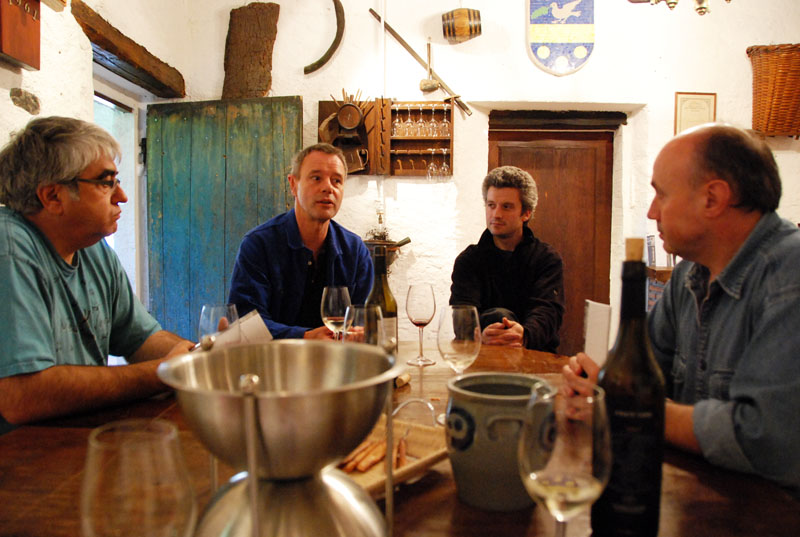
Since Raymond Paccot in Fechy is one of my favourite producers, whose Chasselas stands out in a world of classic Swiss Chasselas, I started there. My husband and I sat down on little three-legged stools at the old wooden table late Friday afternoon in La Colombe’s tasting room.
Two of Paccot’s neighbours, both originally French, were there with pen and order list in hand. They had started on the whites and moved on to the reds. "My list is getting too long," one sighed. The other shrugged and cheerfully pointed out that he would undoubtedly enjoy all of them.
 We started on the whites, first La Colombe, the basic Chasselas which I knew I wanted to buy several bottles of because we often serve it to guests. It is made from grapes grown on several vine parcels around the village, is light and works well with aperitifs or raclette cheese served outdoors on a summer day, something we often do with visitors. I like the fresh fruit tones – strawberry and lemon in particular – that I find there.
We moved on to Le Brez, a beautiful Chasselas from grapes grown on the eastern slopes above the village of Féchy. This is where you begin to understand the concept of terroir: the extent to which grapes are affected by the combination of soil, micro-climate (sun, wind, humidity) and altitude. Like La Colombe, this is a single-grape Chasselas wine, but it is more elegant and interesting, and even the new vintage opens out as you sip it. Paccot recommends leaving it in the cellar for one to three years to really benefit from its complexity.
We then tried a Pinot Gris, simply because this is a grape whose wines I love and Paccot’s version of it is one of the most interesting I have tried, with more fullness than many and unusually long in the mouth.
I was sipping and spitting out the wine, since I was driving home. The other visitors were calculating how much they had consumed since one had to drive. I asked for their suggestions about building a wine collection.
"Oh, that’s a lot of work," said one.
"But it’s worth it," said the other. They agreed on this point.
"You can do it the French way, and buy some for yourself for later and make sure you start to build a cellar for your children," said the other.
Oh dear. I hadn’t thought of my son’s wine collection yet. I’ve barely thought of one for his parents. When Paccot notes that his Chardonnay is best sampled after three years in the cellar I think I would like to hold onto at least one bottle that long.
I explain that we start out with good intentions and then forget to mark which bottles to drink when, so we tend to just drink them as we please.
"You need a large placard in front – ‘don’t touch until 2012’!"
"So, how do you go about adding wine to your cellar?"
Pause.
"Well, we just buy it and drink it," they admitted. Most of the time.
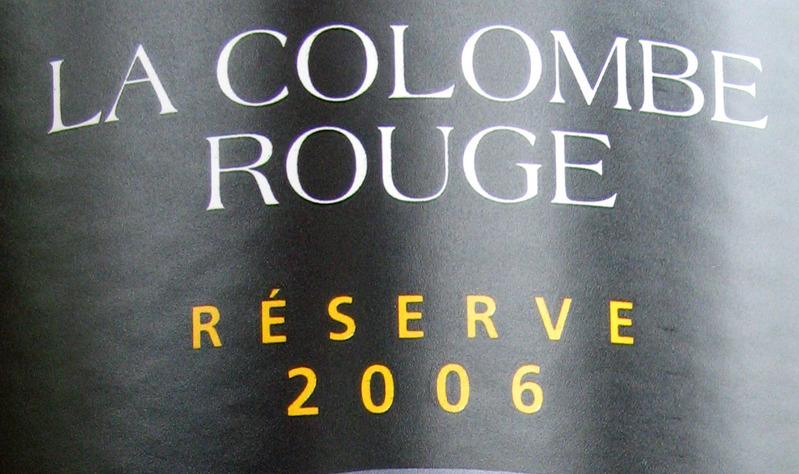
At this point my husband and I decided to try a red, and this was the moment of truth for me. I had intended to order about 12 bottles of white wine, possibly more, but I want to try several other winemakers’ goods this year, and the budget has its limits. I tasted La Colombe Reserve Rouge 2006, a blend that enchanted me (see wine of the week, below). It was promptly added to the list.
Raymond Paccot and his other guests had a lively conversation about the appellation limits for the village and what would happen if, as is under discussion, this is extended. The various terroirs in the vicinity were discussed and my knowledge about these wines increased a small bit as I took this in, another reason for visiting producers.
My advice if you want to build a cellar with good Swiss wines is this:
- start by finding a handful of producers whose wines you’ve tried and liked
- visit their cellars, in the next six weeks, to try the new vintage; many have opening hours, and if not, call to make an appointment
- calculate how many bottles you can afford to buy in 12 months and how much storage space you have for bottles you’ll keep for more than a year, then stick to your budget and space limitations
- read what Cave, a wine club in Gland, says about the ideal cellar and building your collection as well as Swiss wine expert Pierre Thomas’s cost and quality calculations (both in French)
- decide who is driving, and if this is you, DO sip and spit it out so that you can try 4-5 wines without consuming more than a glass, the legal driving limit
- don’t feel obliged to buy during your visit, but take notes, working from the winery’s order list.
Keep in mind that most producers in Switzerland are small businesses and the way they sell their wine is to have people come in and try it. Many don’t sell to supermarkets, so you’ll find these wines only at the cellar or possibly local shops, as well as in restaurants. They’re happy to share their knowledge with you and like to be asked questions, no matter how basic. If you have not planned to buy three or six bottles when you leave, explain that you’re just getting to know Swiss wines and you’ll send your order later. It’s acceptable to ask if they will sell you a single bottle so you can try it at home. If they’ve made you feel welcome they know that chances are you’ll be back again. Or you’ll order by mail, fax or phone.