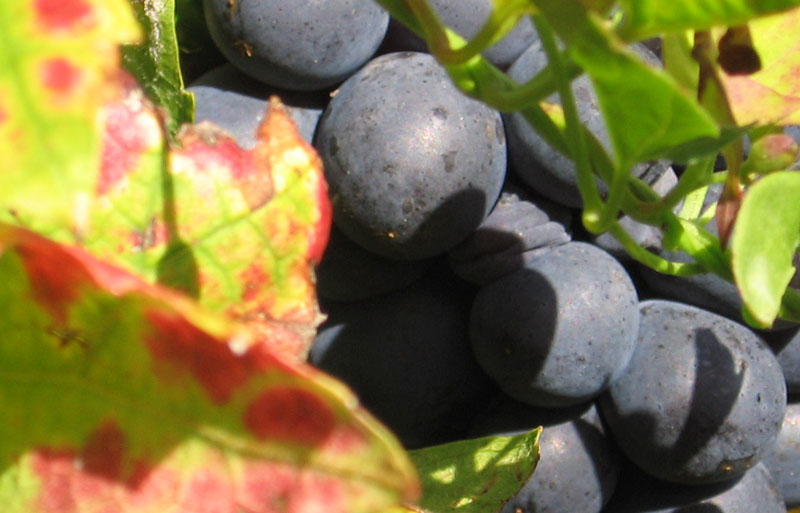
 Geneva grape harvest, 2007 (photo, J Schindall)
Satigny,
Switzerland (GenevaLunch, by Julie Schindall) – “Winemakers must now be not only artisans and farmers, but also salesmen and experts in marketing,” says Roger
Burgdorfer, owner of the Domaine du Paradis winery in Satigny. Burgdorfer speaks
animatedly about the need for innovation and development in the Swiss wine
community as he stands surrounded by his vines overlooking the Salève and the city of Geneva. He argues that the two most pressing issues are the battle against environmental damage and global warming, and the need for training vintners to manage not only their vines but also their balance sheets.
Burgdorfer is clearly passionate about the romance and tradition of making wine, but he is by no means stuck in the past. The son of a Swiss German father who came to Satigny to pick grapes, Burgdorfer established his own winery in 1983, planting grapes and constructing most of the buildings on the farm.
Now a well-known Geneva vintner, Burgdorfer grows 25 varieties of grapes and bottles 20 types of wine at his own cellar. During the
weeks of September and October, Domaine du Paradis is at the height of the grape-picking season, the vendange. Burgdorfer’s work day begins at around 7 o’clock in the morning, and ends, sometimes, at midnight.
This is clearly a labour of love for Burgdorfer. His cellar walls are adorned with prizes from international wine competitions. His friends and colleagues in the wine business, it would seem, are equally passionate. Nicolas Bonnet, Burgdorfer’s longtime friend and owner of Domaine de la Comtesse Eldegarde, is even rumoured to play the piano for his wines. His favourites, he
likes to say, are jazz classics.
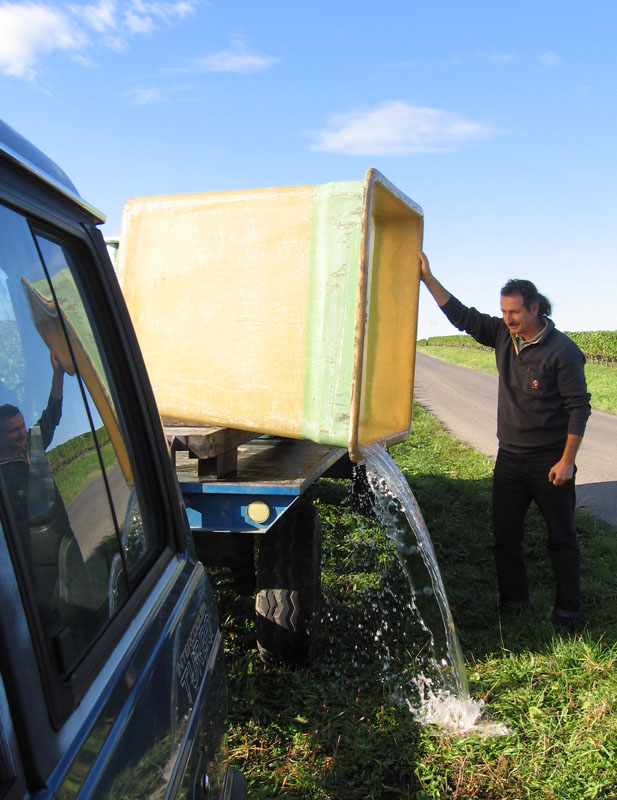
Roger Burgdorfer, Domaine du Paradis, Satigny, Geneva (Photo, J Schindall)
During the vendange season, however, a vintner’s days are filled with more tasks than
playing tunes for his wines. Last Wednesday at Domaine du Paradis, Burgdorfer spent much of the morning driving around his 40-hectare spread collecting filled containers of grapes and transporting them to the cellar, where four employees process the grapes to produce wine. Burgdorfer shares the work of the winery with his wife, son, and a few
permanent staff. His primary job is tending to the grapes.
During the harvest, he relies on large machines rather than traditional hand-picking to cut the grapes. Machines do the work of 20 men, Burgdorfer explains, and while they require an initial investment of over six figures, they save money and hassle. Burgdorfer admits with a rueful smile that he’s glad to end his role as mediator for disputes between groups of seasonal labourers.
The Swiss wine industry has made huge advances over the past two decades, and
the quality of Swiss wines, Burgdorfer and Bonnet say, has increased dramatically. However, Burgdorfer still worries for the future of agriculture in Switzerland. General farming of wheat and corn, he says, is no longer profitable, and farmers are saved only by government subsidies. Swiss wines can compete to some extent because wine is an upmarket product for which
people will pay a premium. Nevertheless, Burgdorfer thinks that agricultural protection in the European Union may eventually threaten the profitability of Swiss wines.
The tradition of making wine in Switzerland dates back to the Roman period, although the Guides des Vins Suisse notes that there is evidence of grapes as far back as 3000BC. Workers from abroad have long helped harvest Swiss grapes, but the pace picked up in the 1970s, when migrant workers from Italy came to Switzerland in large numbers to pick grapes. Waves of immigration brought different groups: Spaniards in the 1980s, and Portuguese in the 1990s.
The 2002 Free Movement of Persons Agreement with the European Union is affecting the type of employees at Swiss vineyards. Workers from Poland in particular are beginning to seek temporary agricultural labour in Switzerland.
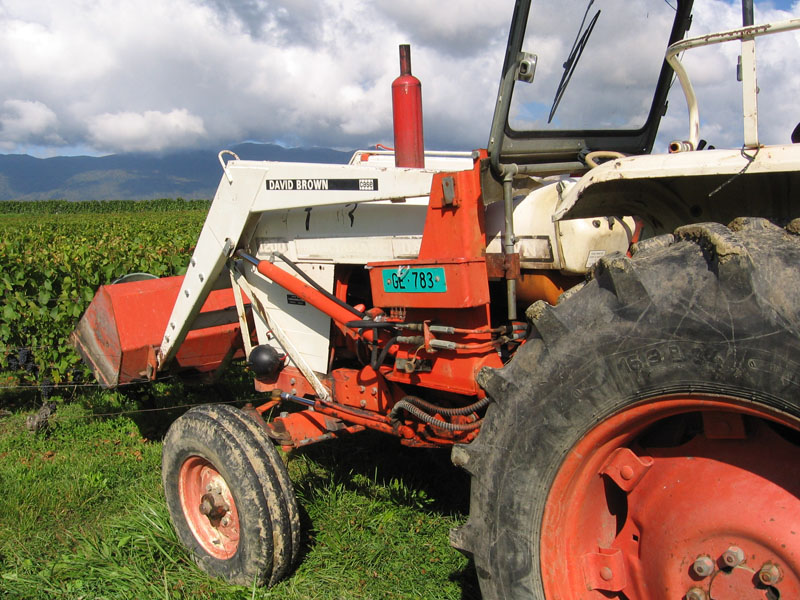 Domaine du Paradis: Large equipment has replaced many of the grape pickers in Geneva (photo J Schindall)
The most talked-about labour development in Switzerland today, however, is the rising use of grape harvesting machines. They cannot be widely used in some areas, notably in Vaud and Valais where the steep slopes pose limitations. They suit Geneva’s vineyards, however. According to Alexandre de Montmollin, director of OPAGE (Geneva Cantonal Office for Viticulture and Oenology), there has been a significant decrease in manual labor for the grape harvest. He estimates that 60% of grapes are harvested by machine and 40% by hand.
At the Domaine du Paradis, Burgdorfer keeps a small year-round staff and tends to use the same seasonal workers for the harvest. He pays them SFr135 per day and
provides lodging at a large building on his property. Burgdorfer speaks French to his foreman, who translates instructions into Portuguese for the workers.
According to Burgdorfer and Bonnet, the overarching concern for Swiss winemaking today is how to remain profitable. Most winemakers believe high quality is the way to success. Bonnet states firmly that winemakers cannot rely on government subsidies. “Switzerland does not support agriculture very well,” he says. Bonnet would rather have liberal markets for all of Europe and be able to
compete openly with other European vintners. “Building barriers – I’m against that,” he says.
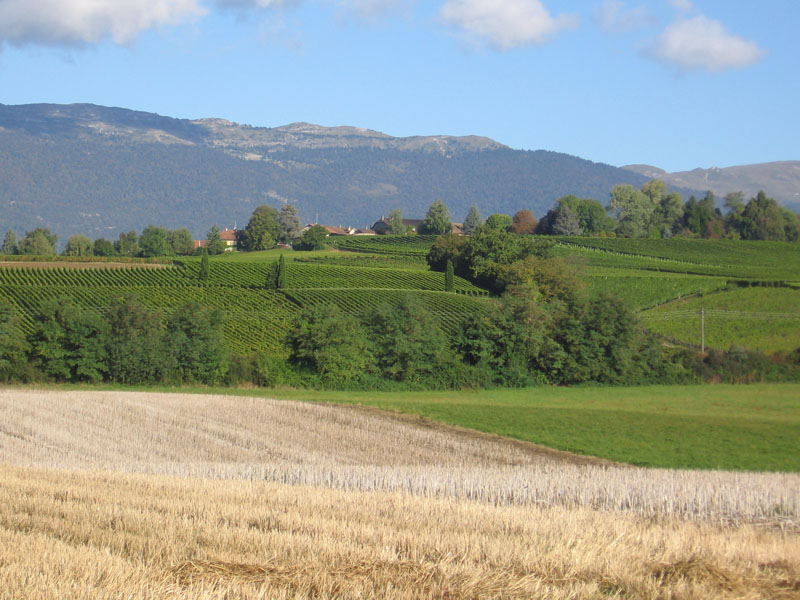 Geneva’s vineyards, harvest time, late September 2007
Burgdorfer and Bonnet remain committed to producing the finest product possible. They point to Geneva-area restaurants and hotels as some of their best customers. They reason that if they can convince Swiss wine drinkers, whose standards are high, perhaps then they can make an impact at the international level.