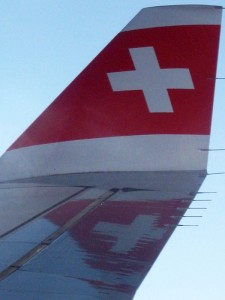
 GENEVA, SWITZERLAND / EDITOR’S NOTEPAD – Swiss media yesterday picked up an article from an Israeli newspaper, about a family that was taken off a Swiss plane in Zurich after their 8-year-old autistic boy had a “crise“.
I didn’t post a news article about it because I wanted to see the public reaction: the newsworthiness of the incident lies in its ability to prompt people to reflect and discuss, not just have an emotional reaction to a difficult situation. For me, this is the value that news coverage in general offers us, or should. News is dirty and cheap when it’s just a spectator sport.
I wasn’t very impressed by the news reports, nor am I surprised. The stories imply, without saying it, that the airline behaved unacceptably. In journalists’ jargon, it’s call creating a narrative of conflict, which always boosts readership.
Swiss, for its part, told the Israeli journalist who covered the story, that what happened “is not characteristic of this company and does not coincide with our policy; on the contrary.” The incident, including cancellation of the family’s return tickets, is the subject of an internal investigation. So far, we have only the family’s version of what happened, which may well turn out to be 100% accurate, or just slightly slanted, understandably.
Autistic children taken off flights, in the news
The story will have immediately provoked editorial room interest because of an incident in the US in May, when a woman and her 12-year-old autistic daughter were pulled off a flight, making world headlines. We all love to fly and we all love to complain about airlines’ insensitivity some of the time. That story clearly hit a nerve.
I have a particular interest in this story: for 21 years I’ve been considering but haven’t been brave enough to take my autistic daughter on an airplane. The last time Tara, who is now 23, flew, she was 18 months old and we managed to fly to the US for some treasured moments with my terminally ill father. My elderly mother, for the next 14 years, had to content herself with seeing photos of her very special granddaughter, and I know that was hard for her. Tara’s other grandmother lives in the UK and until a couple of years ago she was able to travel to see us in Switzerland. Now we need to travel to see her, and so far, a 10-hour car trip is easier than the short flight would be. Sadly, it limits the frequency of our trips.
The facts of the Zurich-Geneva flight story are available only from the original source, Israel Hayom, whose reporter is the only one to have spoken with the family and with a spokesperson at Swiss.
The “facts” of what triggered Swiss to remove the family from the plane appear for now to be these: the family “prepared” the boy for two months for the long trip to see relatives in Switzerland. He managed the long-haul flight fine, but when they boarded a flight to Geneva in Zurich, he “began crying uncontrollably and could not be calmed” and he threw up.
Our experience with autism meltdowns
If my daughter cries, she makes a very, very loud and distressing noise, and if this shifts into a meltdown because she’s overwhelmed, she tends to kick her legs. She’s a slip of a young woman but remarkably strong when she’s upset. If that happened on an airplane, my toughest job would be to keep my own stress level under control so I could help her calm down quickly. That, I know from experience, is really, really hard. You need everyone around you to understand and be patient.
Uncommon and each person is different
The Israeli family’s Zurich story spread quickly from one Swiss media to another, with a relatively high number of comments on each. Public reaction to the story covers the gamut, from bird-brained anti-Jewish remarks (thankfully few) to anger over the family’s treatment to a more general concern about both the family and the airline and how all of us can or should deal with a situation like this. Frankly, I’m pleased at the sheer humanity that surfaces, including some indignation at the approach taken by the news stories.
We don’t know what to do, but we’d like to understand how we can face situations like this. They will arise, not because the family was foolish to take their son on this flight, something I’m not willing to pass judgement on, but because health problems are unpredictable, from heart attacks to births to seizures and other crises on airplanes. An autistic person’s meltdown, as most of us parents call it, is something we work hard to avoid, for their sake as well as ours, but sometimes it happens. Airplanes don’t necessarily provoke it, but first-time situations or the unexpected can.
Seeking solutions – families, airlines, other passengers
How can we help? How can the airlines help? Should families avoid traveling with autistic children, including adult children?
Airlines can start by educating their staff about autism, since they can expect to see more passengers who are autistic. This population is growing for reasons that are too complex to mention here. There is a more widespread understanding today that many autistic people lead relatively normal lives, including travel. More children receive better education and are mainstreamed in schools and live in communities that accept them.
Airlines need clearcut policies and procedures that help staff, including pilots, make quick decisions in case of problems. They need to know how to be aware of potential problems and to know how rarely these actually grow into real problems – also, what to do when that happens. In short, they need to expand existing staff training that covers passenger health crises to include autism, and to develop this they need to work closely with autism groups.
Yes, other passengers will be upset and no, they won’t all understand. The same reactions we heard 20 years ago about people in wheelchairs will surface, such as “why should the rest of us pay for that” and “if it’s too hard, they should just stay home”.
I know families with autistic children who are like Tara, and they fly successfully, for annual family vacations and to see relatives. My daughter has limited verbal comprehension and she doesn’t speak but is capable of making very loud noises or repetitive noises, and she’s a messy eater who loves food, preferably non-stop. She loves cars and trains, and she would love to fly, I’m pretty sure. She might have trouble with delayed flights and long lines and endless crowds, and we don’t fly, not because of her but because of me: overseeing a family flight would exhaust me. She is also, I should add, capable of sitting quietly for hours and when she is peaceful, she wordlessly charms everyone around her.
Yaheli, whose family returned from Geneva to Israel on El Al without incident was able to thank the air crew himself.
The autism spectrum: know at least this much
 Autism isn’t a disease, but a spectrum of conditions with many causes, and it includes very handicapped as well as what is often called high-functioning people. There may be behaviour issues, such as loving to rock in a seat or dribbling food, that other people find odd or annoying, and that the autistic person has trouble managing well. That’s very different from a meltdown, which is close to a panic attack, and not something that’s easy to manage once it gets started.
I think each family has to decide, based on their knowledge of themselves as well as their autistic child, if flying makes sense. It’s impossible to be completely sure you’ll never have a problem. If you know an airline can cope and knows how to help ease the situation, maybe just by bringing a snack or a drink quickly, you’ll probably turn into frequent fliers on that airline.
Explaining to an airline in advance, providing useful information about an autistic passenger before the flight, should be our responsibility as parents, but no one wants to do that unless they are sure the airline has a respectful and welcoming policy.
Maybe we should take spare earplugs and offer them to anyone who is bothered by a loudly crying older child; maybe the airline can keep a small spare stock for noise emergencies.
The right to fly
And then there is the thorny question of whether a person who might upset other passengers has the right to fly. Or to take a train or any form of public transport. The disadvantage of a flight is that you can’t get off easily, of course, and the crew needs to be available to all passengers, not just those with a problem. Safety has to come first, and belligerent passengers who risk harming the crew or the plane are too risky. But an autistic child, or even adult, having a meltdown is not the same as someone who has just downed a bottle of cognac, like the woman in China last week who was thankfully kept off a plane.
For me, these are decisions to be made on a case-by-case basis, but for an airline, there has to be a clear policy, and that’s always going to be a problem.
The desire to help
 When you’re trying to help an autistic family member who is in a difficult patch, it’s hard to even hear other people who are offering to help because you’re focused on what’s going on and trying to defuse the situation.
But if you’re another passenger nearby and you can help, do please, in small ways: get some water or a soft drink, try to think if you have some form of distraction (a small game?), try to quietly get a member of the crew there to provide some real help, maybe make it easier for them to walk down the aisle to a more open space. Talk to people around you to reassure them. Offer to get familiar and comforting things out of bags if they’re needed.
And when you talk to the family of the autistic person, who maybe isn’t looking at you or seeming to hear you, keep in mind that he or she may well hear and understand everything you are saying. Be kind, be generous, assume intelligence, and that message will get through.
A few years ago I was on a very late and overcrowded train from Cardiff to London after a busy work trip, and I realized that a woman nearby was struggling to cope with her young son, clearly non-verbal and autistic and very hyperactive. People around her were glaring as they tried to read their newspapers and she was trying to keep her cool, but the trip ahead was long. It probably didn’t help that she was Nigerian and had two huge suitcases, sitting on a train of Welsh and English commuters.
The glares got worse. I went over and said I had a daughter like that, and what did her son like? Cars, she said. So he and I amused ourselves for three hours pretending we were cars, fingers climbing up and over seats, with me explaining the situation to some of the people nearby, between me talking to him about red cars and blue cars.
He visibly relaxed and played alongside, not with me, while I tried to pick up signals of what he liked or didn’t. His exhausted mother dozed off for a bit after a young man, once he understood, found a better spot for her bags and promised to sit and watch them.
It wasn’t the post-conference relaxing journey home I’d hoped for, but those moments when we put others first always pay us back in spades.
Just do it. Thanks, from those of us who need your help.