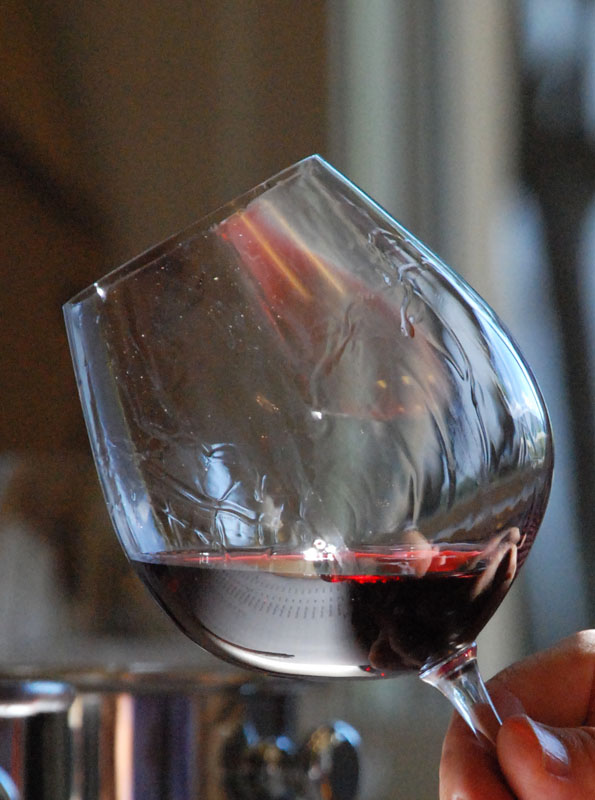
Photo: Had we been able to see our wine it would have looked a bit like this.
Six journalists lined up inside the Town Hall of Sierre, Valais Sunday to do a truly blind wine tasting. We put our left arms on the shoulders of the people in front of us, someone closed a pair of heavy curtains and we were in near-total darkness. Slowly, quietly, we marched into another room and closed the door.
Jean-Marc, the man at the front of the line, was the only confident person. He is sight-impaired, as are two other people who were leading us on this sensorial adventure. It was pitch black in the room. Our guides, experienced at walking in the dark, led each of us gently to a seat. The three were from the Swiss Federation of the Blind and Visually-impaired, which organized the blind tasting as one of the events for journalists at Vinea, a major Swiss wine fair.
“You don’t have anything to worry about,” came a soft voice. “If you are worried or need anything, just call out. You can talk, but try not to be too loud,” they advised us. I found myself tensing to hear every little sound, my only clues to what was happening.
The journalists loved the idea of testing their ability to judge wines without seeing them. Journalists tend to be a brave, or at least adventuresome bunch, and we all said promptly that we weren’t worried.
Two weeks earlier the judges for the Mondial du Pinot Noir, an international wine competition, had done the same thing. The organizers of our blind tasting told us they had made a decision based on that first experience. We would have three wines and they would all be red. Pinot Noir and we weren’t sure if this was an accident or if we were supposed to have this clue. The Mondial judges had whites and reds, and it apparently worried many of them not to be able to first assess the colour. Journalists, even wine writers, possibly worry less about their reputations.
The chair was easy to find in the dark, once I was placed behind it. I sat down and followed the instructions for finding my very large, long-stemmed wine glass, a water glass, a small bottle of water and box of tissues. You place your arms in front of you, slowly, spreading them out to the sides a bit, then you move them cautiously to the center.
I promptly sketched a mental picture of where everything was placed, and I was careful not to move objects too much. A voice in the dark called each of us by name as she came around with the bottle. A hand landed softly on my shoulder and she asked for my glass. Putting my nose to the glass posed no problem but I decided that with a smaller glass I would probably not have managed to put nose to glass so quickly. At least no one would have seen me blush when I put my chin in the glass instead.
The real test, of course, was how well we felt we could judge the wine. I was startled by how much more I noticed the alcohol and how much less nose it seemed to have than wines I had been tasting at Vinea for the past two days. Was this a truly austere wine? Was it young? I found I wasn’t very confident about the parameters for judging. Marc Vanhellemont, who writes for the Belgian magazine, In Vino Veritas and Stephen Brook, who writes for Decanter, are both far more experienced wine writers and they promptly gave their verdict. Stephen liked it, Marc less so. Alexandre Truffer, a young Swiss wine writer whose web site, Roman du Vin, is a good source of information about Swiss wines, agreed with Marc. The rest of us said little.
We were given a second one, a wine I felt more at home considering. And a third one. After general comments on each we were asked to order them, 1-2-3, by our preferences. There was a strange clicking noise at the opposite end of the room, which was later explained as Jean-Marc punching a braille card with our votes.
The Mondial judges had a tougher task, having been given just three minutes per wine and then asked to rate several specific wine qualities. Everyone but Stephen voted for number two as the favourite. Brook, a quiet Englishman, cheered when it turned out that his preference for number one, indeed a more austere wine, matched the choice of most of the judges although he was the only one in our group to put it at the top of the list. I was going to say he raised his arm and cheered, but I can’t say I saw the arm.
We all felt that tasting wines blind was initially a bit disconcerting, but that we quickly adapted to it. Did it have any real impact on our assessment of the wine, we were asked. We think not. It would be hard to do a followup test with us viewing the same wines because we would probably be seeking clues we remembered from the first, blind session.
One difference I noticed was that in a very quiet room, with no distractions, I was far more focused on the wine and the job at hand. I now wonder what it would be like to taste wine, seeing it, but in total silence. I’ve put airtight earphones on my Christmas list in place of a new corkscrew.