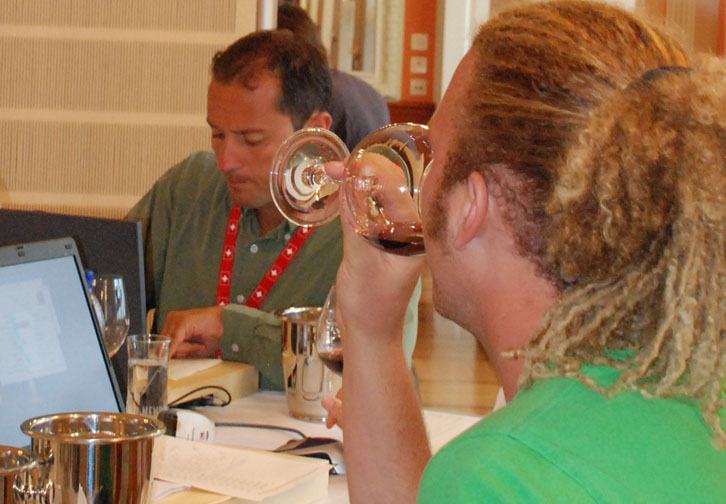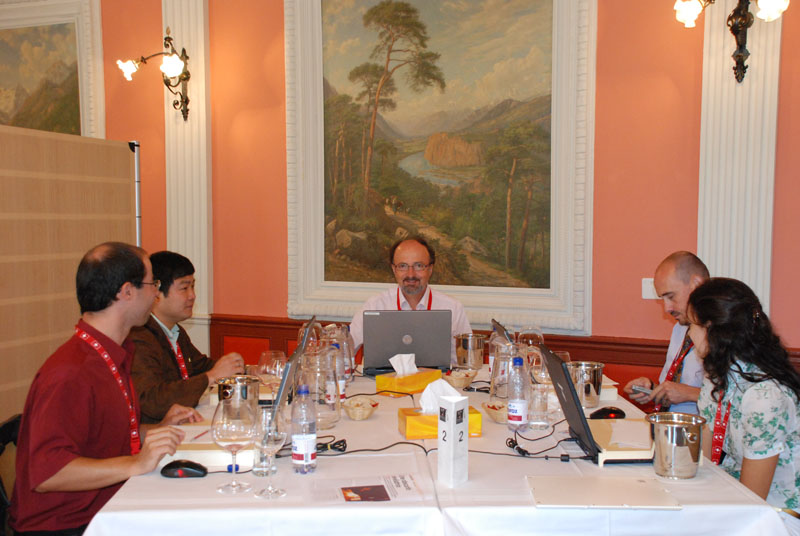
Photo, top: an unusal feature at the Mondial du Pinot Noir this year was a truly blind tasting, with small groups of judges led into a darkened room where they tasted wines without the benefit of seeing them.
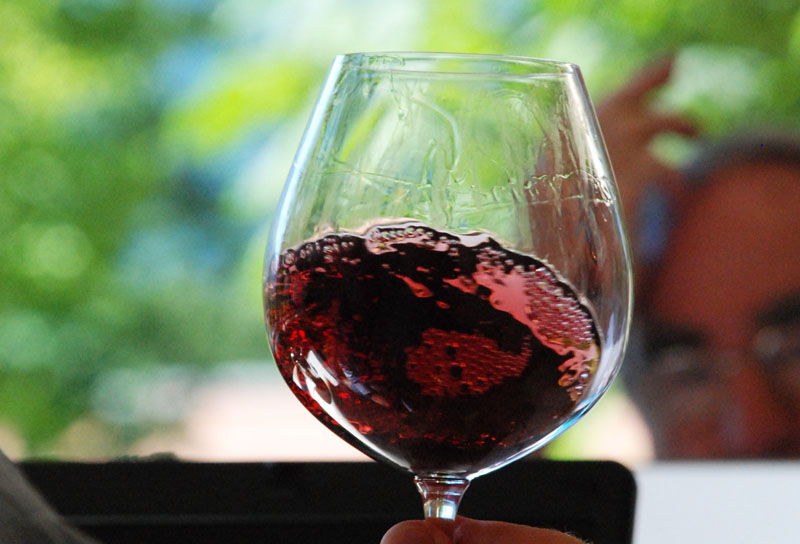
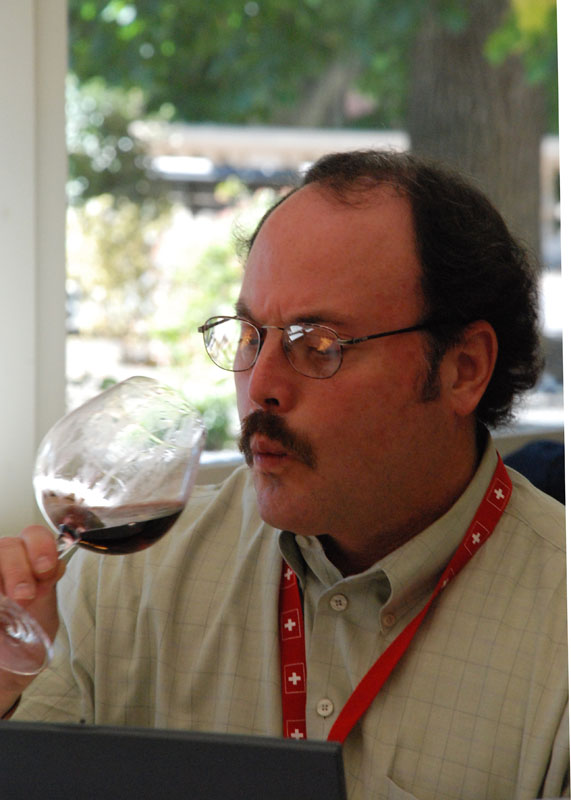
Photo, below: much is learned about a wine simply by looking at it in the glass, watching it move.
Sierre, Valais, Switzerland – Pinot Noir wines flowed this weekend in Sierre, but within the confines of a strictly controlled international competition rather than for consumers. The elegant old town hall of Sierre, with views of the Val d’Annivier peaks, played host to tables of judges silently tasting, considering and putting their decisions into a computer.
A handful of winemakers from around the world will receive what can be viewed as one of the top global wine accolades when the results of the 10th annual Mondial du Pinot Noir competition are announced 27 August. More than 1,050 wines were entered from several countries, with a strong increase in French and German wines this year.
Pinot Noir, the grape variety that lies behind Burgundian wines’ renown, is loved by the best producers because of the challenge it offers their skills. The grape can be grown around the world, but it is very sensitive to climate and soil as well as the vinification process.
 In the hands of a skilled winemaker it can produce some of the world’s top wines.
“Pinot Noir has always been the holy grail of winemakers,” says Lilyane Weston, a French judge who says that her own favourite Pinot Noirs are often from New Zealand.
Yann Juban, deputy director of the Paris-based OIV (Organisation Internationale de la Vigne et du Vin), says that what makes Pinot Noir so special is the variety of “expressions” of the grape. “It has such rich potential to be varied and it is so delicate, something you don’t find with other grapes. The best Pinot Noirs really show what the hand of man can do.”
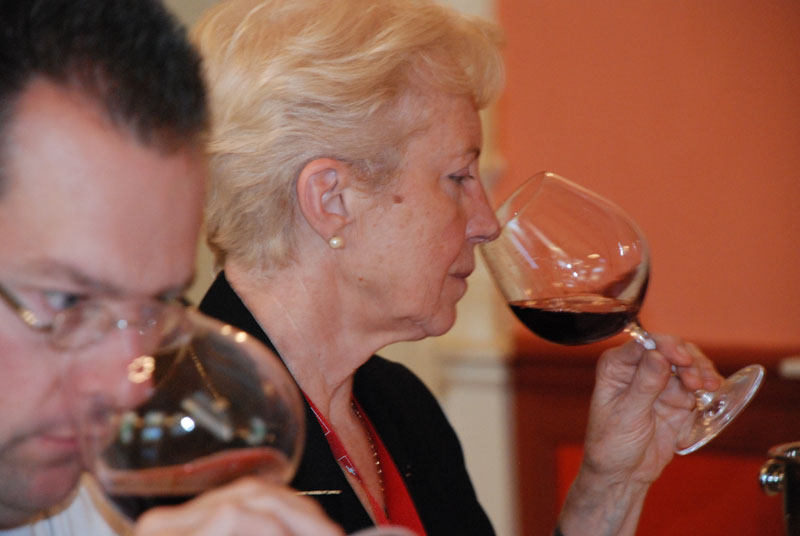
Switzerland’s Mondial du Pinot Noir was the first single-variety wine competition and it has rapidly become popular with judges. For Weston, who often serves as a judge in competitions around the world, the Mondial is her favourite. It provides “three of the most enjoyable days in the year.” She cites the “fantastic setting, the wines are interesting and it’s all very well organized.” But the nature of the Mondial du Pinot Noir itself also makes it special. “I think the fact that you can focus on one grape variety is fantastic. Wine tasting is very humbling and here you have this great learning experience.”
Noticeably absent were US wines, whose producers do not frequently participate in international competitions. The only American judge at the Mondial, Michael Schaefer, is director of the Society of Wine Educators. He noted that Americans, from producers to marketers to judges, are for the most part outside the loop of international competitions. “We’re a little isolationist, where wine is concerned. The US is not in the OIV, and there’s not a coordinated effort in the US to enter these competitions.” The explanation lies in the fragmented market he believes. “You can go into a Safeway in California and you won’t find the same bottles you find in New York at a Safeway. All the states have different rules. There’s no cohesive way of distributing wine.” As a result of this “fractured system,” says Schaefer, there is no central clearing house for the industry.
US wine producers are not likely to enter competitions, he says unless or until export markets become important to them, at which point international competitions begin to carry weight. As a result, “many of these competitions have almost no impact on the US market.”
Pinot Noir received a boost with consumers in the US and elsewhere from the 2004 movie, “Sideways.” It came on the heels of a revival in the industry that had much to do with new world Pinot Noirs gaining attention. Ten years ago, says Juban, the grape variety was in the doldrums, with fears voiced that it was “losing its soul.” It lost ground to blended wines, which were increasingly popular in the late 1990s, but then “new world wines sparked interest in single grape variety wines again,” he notes.
The Mondial is a showcase for producers, whose stocks of other wines may be larger: the yield of Pinot Noir is inferior to that of many popular grapes such as Sauvignon Blanc. The Mondial is also, according to Weston, a chance for judges to really test wines from well beyond their own regions. In London, she says, she is lucky to be able to sample wines from everywhere on a daily basis, but this is far from the norm for judges. “If you don’t know enough wines, if you are really only familiar with your own region, it is difficult to be open enough to other wines.”
Sierre’s Mondial goes some way towards correcting that.